
Final Model Update - 11/4/24
With the final update of the model for the 2024 election, Democrats are ahead by 3 points.

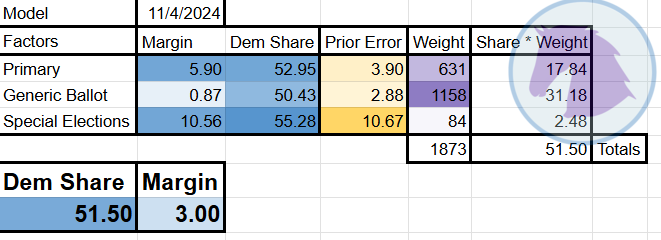
With this being the final edition to the model updates for 2024, Democrats have ended the campaign by being ahead by three points (exactly, funnily enough). This is not as high as it’s ever been—having peaked in September at D+4.1—but is still a solid, but small, Democratic lead.
Any change essentially since the end of the DNC has been shifts in generic ballot polling, with primary and special elections having little to update on since. Said polling now shows Democrats ahead of Republicans by just under a point at 0.8, according to FiveThirtyEight, with Democrats at 46.5% and the GOP at 45.7%. This still leaves a significant amount of undecideds, which can throw the race heavily to one way should they break heavily for one party. Given that, if generic ballot polling end up off of the final result, this could be partially why.
Looking back at primaries and special elections, we can see they both show a much more Democratic environment than polling (not just generic ballot, but presidential and statewide polls too). Part of this may be them having ended during more peak Democratic moments—when Democrats’ enthusiasm advantage was higher. If they are wrong, this could be one of the reasons why they are off. Undoubtedly though, they diverge heavily from the current consensus of a tied race.
This puts us all at D+3.0. This leaves the Democratic Party and Harris with a definite advantage going into election day tomorrow (more so than what polling gives them), but one that could still see Trump and the GOP win if they are lucky enough. Looking at things from a retrospective view of the model, the final margin has been off by up to a point in most cases. If this occurs in either direction, it shouldn’t change things too much, but gives either side more of a clear advantage. Worst case, if the model’s prior error record (2018’s and 2010’s 3-point and 4-point error, respectively) repeats, this could shift the race into landslide territory for either party (although, to be fair, both of those extreme cases happened when polling showed both similar margins and large errors). Interestingly however, this happening would—at least if it happens in Democrats’ favor—agree with the non-polling sections of the model.
No matter what, this election was hard fought, and seems closer than we are used to. That doesn’t mean the result will be close though, as either party could feasibly win complete control of the federal government through a trifecta. But I would rather be the Democrats right now.
“Go vote!” -Josh Taft